Credit-linked courses that build employability
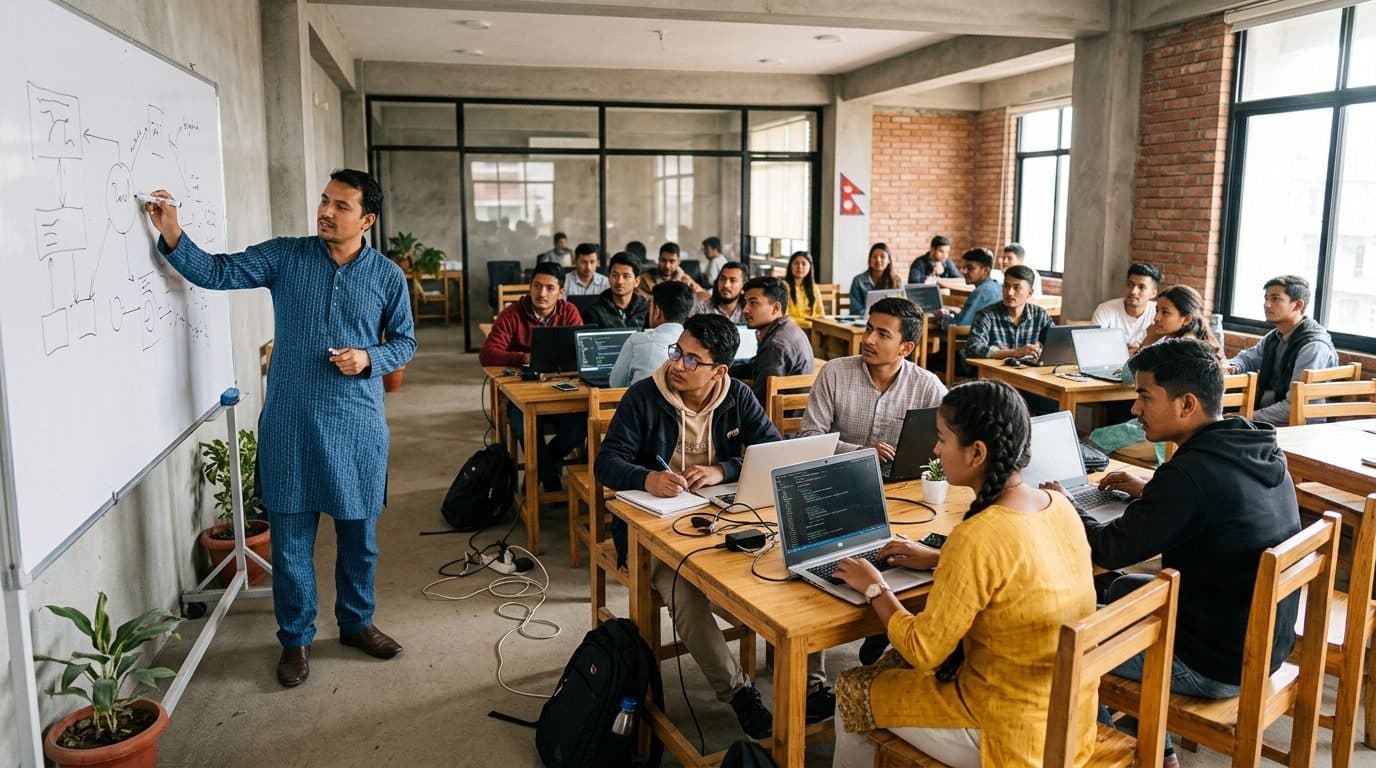
- Approval and hosting of the credit-linked course
- Syllabus and schedule alignment
- Nomination of students into training and project mentorship
- A faculty coordinator
- Better student employability and placement outcomes
- Stronger industry connections
- Credit-linked courses aligned with the syllabus
- A route from student projects to startups
- A 10% share of the training fee
Every partnership is set out in an agreement with the college.
Two ways to run the course
Each credit-linked course is 10 hours, mapped to three credit hours. Choose the format that suits your calendar.
Semester break mode
An intensive block that covers the whole course during the break.
Sunday mode
One session every Sunday, alongside regular classes and without changing the timetable.
Fees for college programs
All amounts are in Nepalese rupees. Industry partnerships carry no fee.
| Item | Charged per | Price |
|---|---|---|
| Skill session | per session | NPR 2,500 |
| Credit-linked workshop (10 hours)Maps to three credit hours | per workshop | NPR 25,000 |
| Group career counseling | per session | NPR 10,000 |
| One-on-one career counseling | per student | NPR 250 |
| Training + internship (3 + 3 months)Returned to the student at the end of training | per student | NPR 21,000 |
| Final-year project support | per group of 5 | NPR 20,000 |
The training fee carries a 10% share for the college and a 10% discount for the student. Invoicing, timing and documentation are agreed in each partnership agreement.

Everything agreed up front
- Course approval and credit recognition
- Session schedule: semester break or Sunday mode
- Faculty involvement and a coordination point
- Batch size and student nomination
- Internship numbers and hosting
- Fee handling, college share and student fee return
- Reporting and review cadence
From first meeting to first batch
- Step one
Partner meeting
We explain the credit-linked model and hear your priorities.
- Step two
Syllabus and skill mapping
We review your course content, map the gaps and design the course.
- Step three
Agreement
Scheduling, faculty involvement, batch sizes, internships and fees.
- Step four
Launch
Credit sessions and counseling first, then training, internships and mentorship.
What colleges ask us
Approve and host the credit-linked course, align the syllabus and schedule, nominate students, and name a faculty coordinator.
The course is 10 hours and worth three credit hours. It runs as an intensive block in the semester break, or every Sunday during the term, on a schedule agreed with the college.
Better student employability, stronger industry links, courses aligned with the syllabus, a route from student projects to startups, and a 10% share of the training fee.
There is zero net cost. The training fee is returned to the student at the end of training.
Students work in groups of five for 4–6 months, alongside the pathway, with supervision from topic selection to delivery. Strong projects may be co-funded by Iraa Ventures toward a startup.
Bring Seepshila to your campus
Tell us about your college and programs. We’ll arrange a meeting with your faculty.